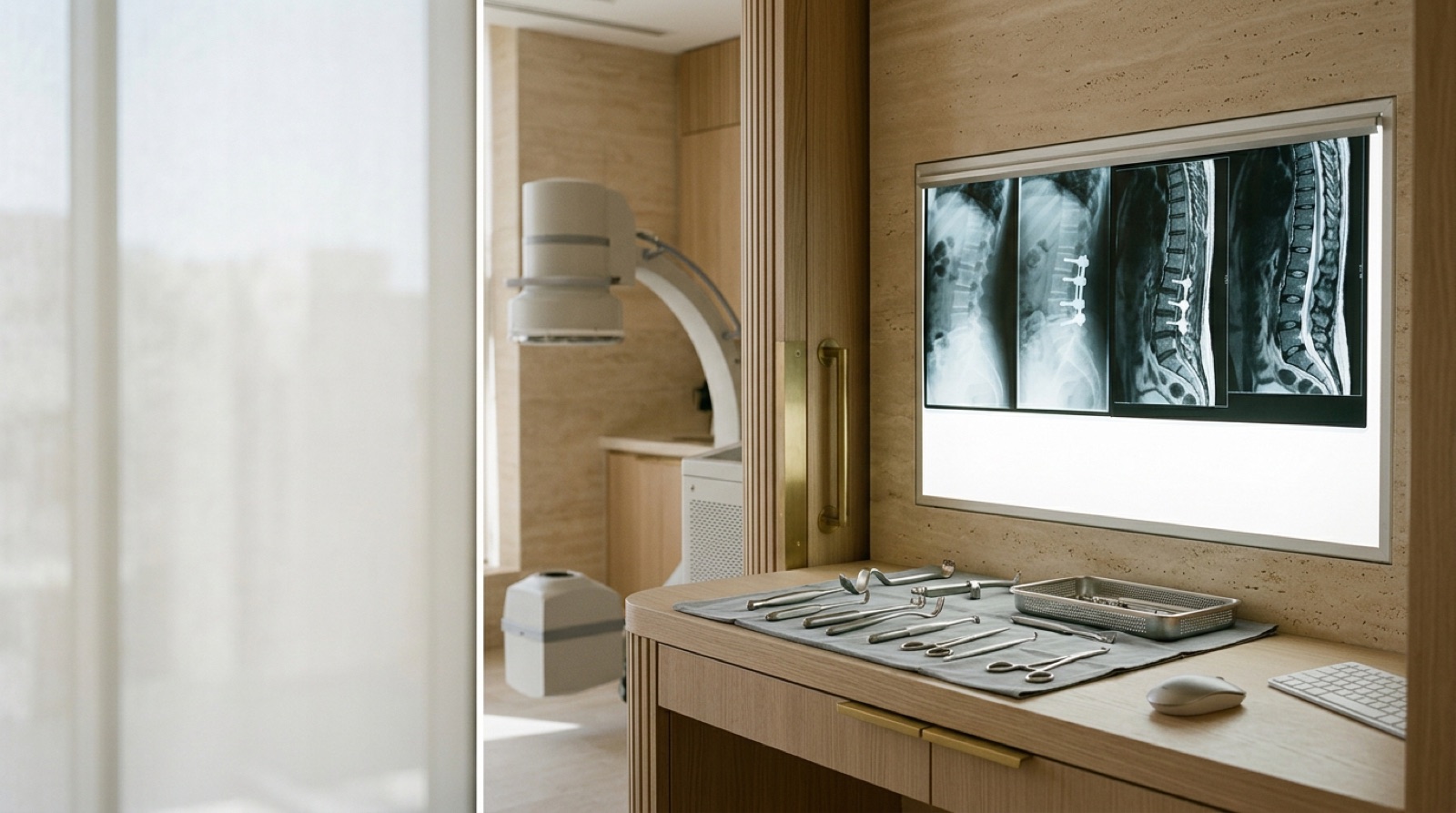
Deformity Correction
Corrective Orthopaedic Surgery
Restoring normal alignment, function, and stability to bones and joints that have developed abnormally or been damaged — to relieve pain, improve movement, and prevent further deterioration.

What It Is
Restoring Alignment and Function
Professor Al-Othman performs corrective procedures across the spine, limbs, and joints, drawing on fellowship training in spinal deformity correction and advanced reconstructive techniques.
Each plan begins with precise imaging and surgical planning, so the correction is tailored to your anatomy and your goals.
What He Treats
Types of Corrective Surgery
Spinal Deformity
Scoliosis and kyphosis correction with rods, screws, and fusion; spondylolisthesis reduction; and post-traumatic realignment.
Limb Deformity
Osteotomy for bow legs or knock knees, limb lengthening (Ilizarov), malunion correction, and rotational correction.
Joint Realignment
High tibial osteotomy to offload an arthritic knee and delay replacement; pelvic osteotomy for hip dysplasia.
When It Helps
Signs It May Be Needed
- Visible deformity of the spine or limbs, or alignment that is progressively worsening
- Pain that has not responded to conservative treatment
- Difficulty walking from a leg-length difference or angular deformity
- Neurological symptoms from spinal deformity, or rapid curve progression in adolescent scoliosis
- Failure of a previous surgical repair
Causes
Where Deformity Comes From
- Congenital — abnormal bone formation before birth
- Developmental — scoliosis or hip dysplasia developing during growth
- Post-traumatic — fractures that heal in poor position or fail to heal
- Degenerative — arthritis causing progressive joint destruction
- Neuromuscular & iatrogenic — muscle imbalance, or complications of previous surgery
Treatment · Step One
Non-Surgical Options
Not all deformities require surgery. Many are managed conservatively, especially in the early stages.
- Observation — monitoring mild deformities that may not progress
- Bracing — spinal braces for adolescent scoliosis; leg braces for childhood angular deformity
- Physiotherapy & orthotics — strengthening, flexibility, shoe lifts, and custom insoles
- Injections — pain management for degenerative conditions while monitoring progression
Treatment · The Operation
The Surgical Process
Surgery is considered when conservative measures fail, deformity is progressing, or function is significantly impaired.
- Imaging & planning — X-ray, CT, and MRI, with computer-assisted planning for complex deformities
- Osteotomy — bone is cut and repositioned to the desired alignment
- Fixation — plates, screws, rods, or external frames hold the correction while it heals
- Bone grafting — used to fill gaps or promote fusion where needed
Recovery
What to Expect Afterwards
- Spinal deformity correction — 5 to 7 days in hospital, limited activity for 3 to 6 months, full recovery in 6 to 12 months.
- Limb osteotomy — protected weight-bearing for 6 to 12 weeks; bone healing in 3 to 6 months.
- Limb lengthening — a gradual process over months, with the external fixator worn until new bone solidifies.
Physiotherapy is essential throughout, to restore strength, flexibility, and function.
Honest Counsel
Risks & Complications
Corrective surgery is complex. Risks include infection, nerve or blood-vessel injury, hardware failure, nonunion (bone failing to heal), recurrence of deformity, and blood clots.
These are discussed in detail during surgical planning, so you can weigh the benefits and risks with a clear understanding before deciding.
The Goal
Correcting a deformity is about restoring
how you stand, move, and live.
Red Flags
Seek Emergency Care
- Fever above 38.5°C, or increasing wound redness, swelling, or drainage
- New or worsening numbness or weakness
- Severe pain not controlled by prescribed medication
- Loss of bladder or bowel control (after spinal surgery)
- Calf pain or swelling, which may signal a blood clot
Get Started
Living With a Deformity?
If a bone or joint deformity is affecting your function or quality of life, call +966 50 580 8852 to discuss whether corrective surgery is right for you.
Related
Related Spine Care
Lumbar Fixation
Spinal fusion to stabilise the spine, often part of deformity correction.